The project

Connecting Canadian energy to global markets

Pacific Link will connect Alberta's abundant energy resources to Canada’s west coast, where it can reach Asia-Pacific and other global markets and strengthen Canada's position as an energy superpower.

Pacific Link will consist of four core components: a receipt terminal in Alberta that collects crude oil, a high-voltage power line, a long-distance transmission pipeline that carries the oil from Alberta to British Columbia and a delivery terminal and marine facility that stores the oil and transfers it to tankers for transport to destinations in Asia-Pacific and other global markets. This significant new infrastructure will be capable of transporting one million barrels per day of Canadian oil.

Receipt terminal

The receipt terminal, located in the Bruderheim area of central Alberta, will serve as a central hub where crude oil from various provincial pipelines is received, measured, stored and readied for transport to Canada’s west coast.

Pipeline route

Pacific Link will span up to 1,250 kilometres between Alberta and British Columbia, following the path of existing infrastructure where possible to reduce new land disturbance.

Delivery terminal and marine facility

The delivery terminal, to be located in the Delta area of British Columbia, will receive and store oil delivered by the pipeline. The marine facility will load oil onto tankers for shipment to global markets.

Receipt terminal

The receipt terminal in the Bruderheim area of Alberta will collect crude oil from various pipelines in the province and serve as a central hub where product will be received, measured, stored and transferred to the pipeline.

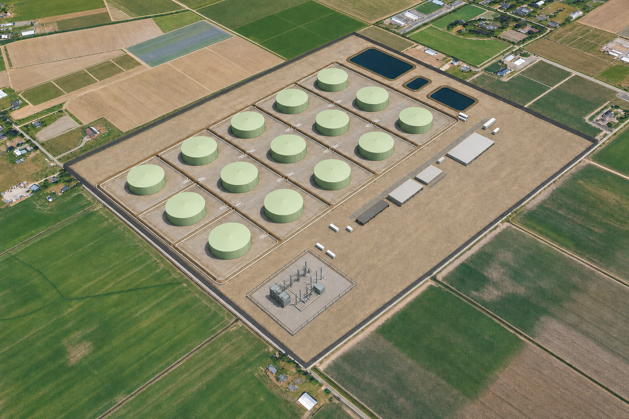
The receipt terminal will cover about 50 to 60 hectares and have approximately 15 tanks in which about 6.5 million barrels in total can be stored. The project will determine the final location for the receipt terminal through engagement with Indigenous groups, engineering and field studies and consideration of culturally and environmentally sensitive areas.
Proposed pipeline corridor

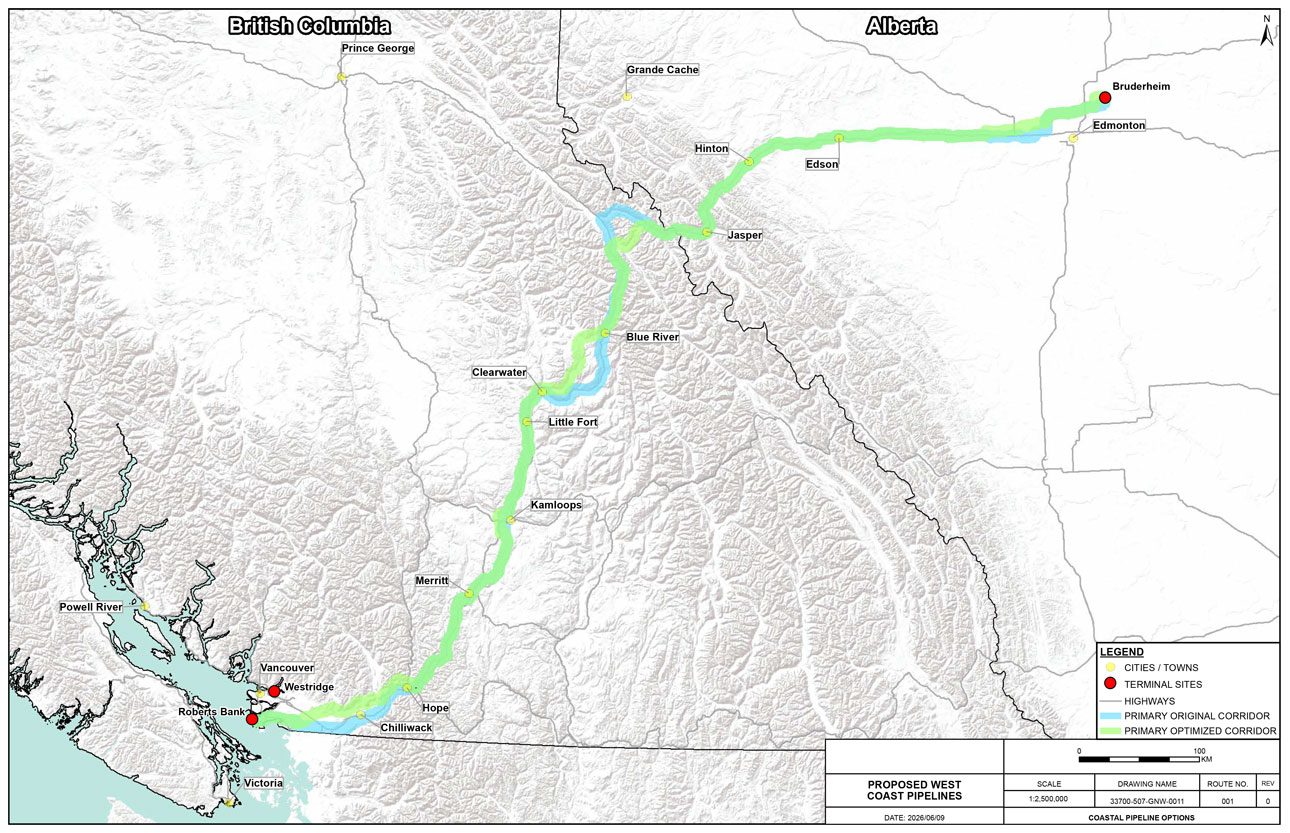
Pacific Link will transport crude oil from Alberta to Canada’s west coast, spanning up to 1,250 kilometres, depending on the route chosen.

The project is considering two corridors for the pipeline:

  • The original corridor stays within 100 metres of existing infrastructure or land that has been disturbed by previous development for 92 per cent of the route.
  • The optimized corridor provides a more direct route and stays within 100 metres of existing infrastructure or land that has been disturbed by previous development for 82 per cent of the route.

Both route options begin at the receipt terminal in Alberta, primarily follow the existing Trans Mountain pipeline system near Wabamun, to the Alberta-B.C. border. In B.C., the routes continue along the Trans Mountain pipeline corridor until they reach Hope, B.C., at which point they branch off to reach the new delivery terminal and marine facility.

Where feasible, the route will primarily follow existing transportation and utility corridors, including the existing Trans Mountain pipeline corridor, to minimize environmental disturbance and land-use impacts. The final route and project design will be informed through engagement with Indigenous communities, landowners, stakeholders and local communities in Alberta and British Columbia.

Delivery terminal and marine facility

The delivery terminal and marine facility are the end point for Pacific Link. After travelling up to 1,250 kilometres from the terminal in the Bruderheim area of Alberta, crude oil will be transferred to the delivery terminal before being loaded onto ocean-going vessels at the marine facility.

Delivery terminal 

The delivery terminal receives oil from Pacific Link and prepares it for delivery to the marine facility. The proposed plan for this 55-hectare terminal includes:

  • An inlet facility that cleans and prepares crude oil
  • 15 storage tanks with safety and containment systems
  • A tank manifold that can move oil from pump to tank or between tanks
  • Equipment for measuring and transferring oil to the marine facility
  • An electrical substation
  • Fire suppression systems

Marine facility

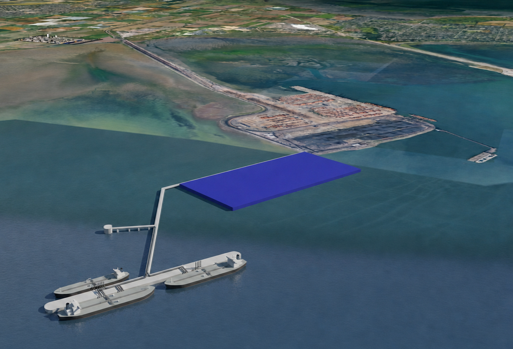
The marine facility receives oil from the delivery terminal and loads it onto ocean-going vessels via marine loading arms. The proposed plan for this eight-hectare facility includes:

  • A causeway and jetty
  • Marine loading arms
  • Two loading berths for large crude-oil carriers (2.2-million-barrel capacity)
  • A variety of safety features
Aerial view of a coastal area with two docked ships connected to a pier extending to a large blue rectangular floating platform in the water near an industrial land section.